We built a product called ReQloth. It is not a product we sell today. We are writing this up because a consultancy that only publishes the things that worked is telling you half of what it knows, and the half it leaves out is usually the more useful half.
Where it came from
The textile sorting work we did with Wargön Innovation, described in our note on sorting used textiles, put us deep inside the problem of deciding what a garment is and what should happen to it next. That work happens at industrial scale, on a line, with instruments.
The question that followed was obvious enough that we could not leave it alone. If the hard part is classifying a garment, and a phone in someone's hand already contains a very good camera, why is the sorting happening at the end of the chain instead of at the start of it?
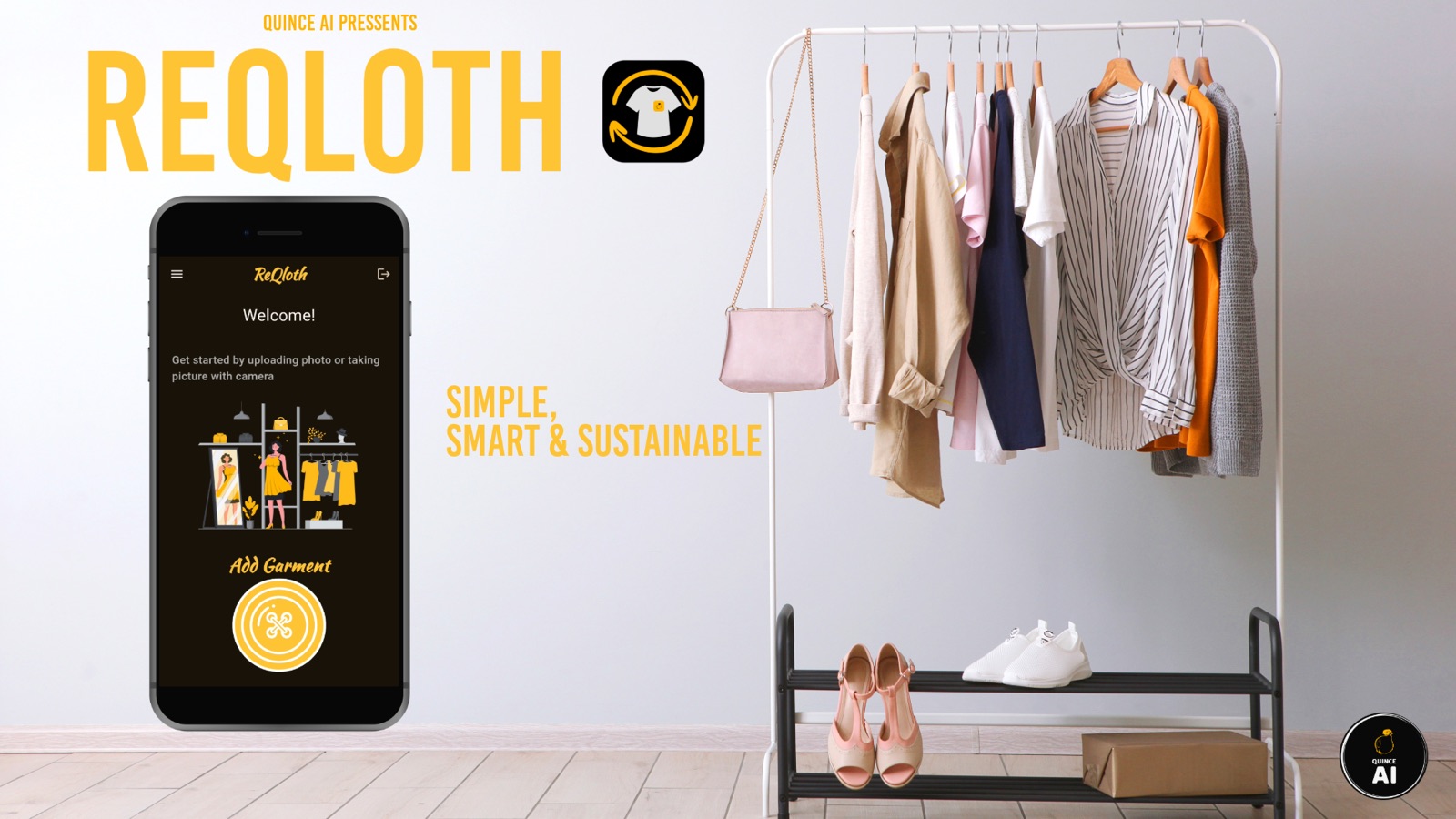
That was ReQloth. Sort at home, not at a facility.
What we built
The premise was to skip the middle of the chain entirely. Rather than move textiles by truck to a sorting facility and pay to have them assessed there, let the person holding the garment photograph it, and let the assessment happen at that moment.
- Assessment from a photo. A user photographed a garment and the model returned an assessment: what it appeared to be, its apparent condition, likely material, and whether it was a realistic candidate for reuse rather than recycling. The listing data filled itself in, which mattered because the entire premise collapses if a user has to type in twenty fields per garment.
- An estimated value. The assessment produced a price expectation, so a user could see whether a bag of clothes was worth listing at all.
- Matching to real buyers. Assessed garments were matched to local second-hand shops, reuse businesses, and companies that wanted specific materials, then offered as a bidding list rather than a fixed price sale. This is the same idea we later built into Qonverge: classification is only useful if it terminates in a buyer.
- Local first. Matches were biased toward the same region, because a circular claim that depends on shipping a used jumper across a country is not a circular claim.
The bet underneath all of it: if sorting happens at the source, the expensive sorting facility in the middle stops being necessary.
Why we thought the timing was right
From January 2025, EU rules required member states to collect textiles separately from other waste. We read that the way most people did. A legal requirement to separate textiles would push volume into the collection system, the system would strain, and a tool that sorted at the source and connected supply directly to demand would be useful precisely when the strain arrived.
The reasoning was sound. The conclusion was wrong, and the gap between those two things is the point of this note.
What actually happened
The regulation did what we expected. People followed it, volumes went up, and collection points and sorting stations were overwhelmed quickly. What we had not modelled was what happens next when infrastructure is overwhelmed.
It does not get more sophisticated. It gets simpler.
Under pressure, municipalities converged on the least complicated instruction they could give a citizen: take usable clothes to your nearest second-hand shop, and take the rest to the recycling centre. That advice is sensible, and it is also the exact opposite of what ReQloth needed. Our product monetised the friction between a person with clothes and a business that wanted them. The official guidance removed that friction by pointing people at a shop down the road.
We built a bridge, and while we were building it the authorities told everybody to use the ford.
The buyer side went the same way. Second-hand shops were not short of supply, they were flooded with it. A platform that helps you source used garments has little to offer a business already turning donations away at the door. Both sides of our marketplace weakened at the same time, and for the same reason.
What we got right, and what we got wrong
The technology was not the problem. Assessing a garment from a consumer photo, filling a listing automatically, and matching it to a buyer all worked well enough to demonstrate, and that capability did not evaporate when the product did. It is the same lineage of work we now apply to industrial materials classification.
What we got wrong was more fundamental, and it was a market judgement, not an engineering one.
- We treated a regulation as a market. A rule that forces a behaviour creates volume. It does not create willingness to pay, and it does not tell you who ends up capturing the value. We assumed the strain would create demand for a smarter tool. It created demand for a simpler instruction.
- We modelled the steady state, not the transition. Our thinking described how textile flows might work once everyone had adapted. Almost all of the interesting behaviour happened during the adaptation, and during that period the actors we depended on were making emergency decisions, not optimising ones.
- We had no read on the policy response. We tracked the regulation carefully and never asked what municipalities would do when the system buckled. That single unmodelled actor decided the outcome.
- We validated enthusiasm instead of behaviour. Interest from shops, brands, and consumers was genuine and easy to collect. None of it was a commitment to change how anyone actually disposed of a jumper on a Tuesday.
What it changed about how we work
This is the part with consequences for anyone who hires us.
The ML Feasibility Sprint exists in the shape it does because of ReQloth. It is deliberately two weeks and a fixed price, and it deliberately ends in a written recommendation that is allowed to say no. When we assess a use case now, we ask who captures the value and who could remove the problem entirely, alongside whether the model can be built. We would rather find the answer in a fortnight than in a launch.
We also stopped treating a regulatory deadline as evidence of demand. Regulation reliably creates activity. Whether it creates a business is a separate question, and it needs its own answer.
Writing this costs us nothing we value. We would rather be the consultancy that shows you a product it stopped building than the one that quietly deletes it. When we tell a client that machine learning is not worth it for their use case, this is the page that says we mean it.
If you are building in this space
Textile circularity is a real problem and it has not gone away. Separate collection is still required, the volumes are still large, and the sorting question we worked on with Wargön Innovation is still unsolved at scale. If you are working on it, our view after building and stopping ReQloth is narrow and specific: the technology is ready, the consumer-facing marketplace is not the place the value sits, and the actor to understand before you write a line of code is the municipality.
If you are weighing something similar, whether in textiles or another materials stream, the ML Feasibility Sprint is two weeks at a fixed price and ends with an honest answer. Sometimes the honest answer is the one we had to learn the expensive way.